
Quick Summary
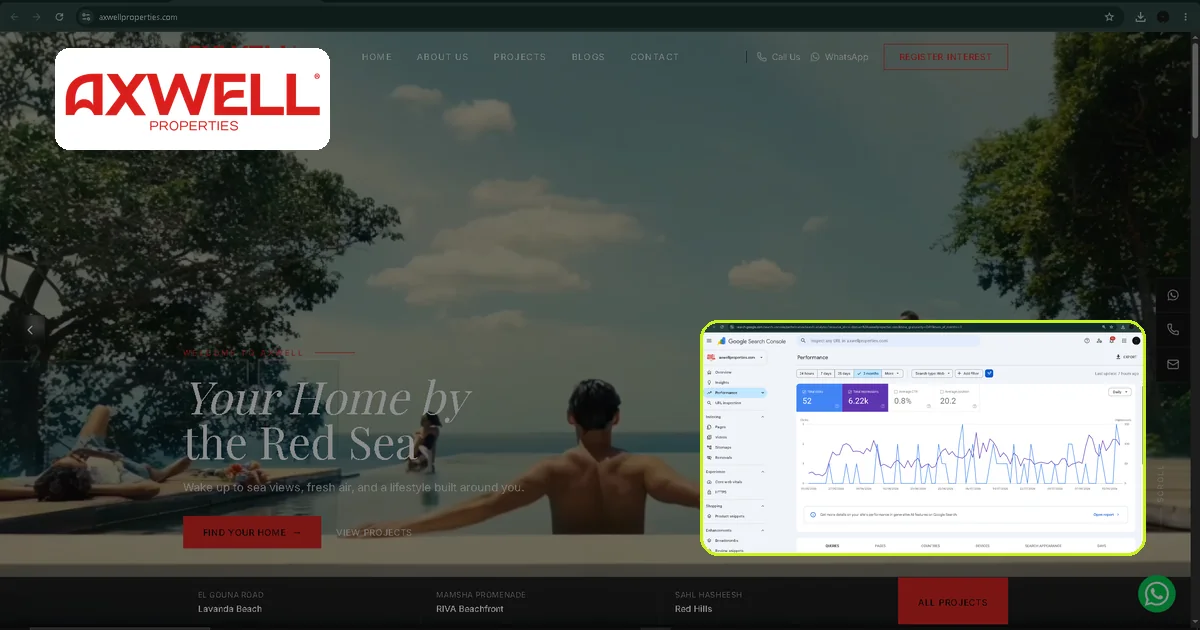
- Axwell Properties is a Red Sea real-estate website whose live footer publicly credits IDEONIC Solutions as the developer.
- The live experience organizes project discovery across Hurghada and Red Sea locations, including featured developments and a Soma Bay collection.
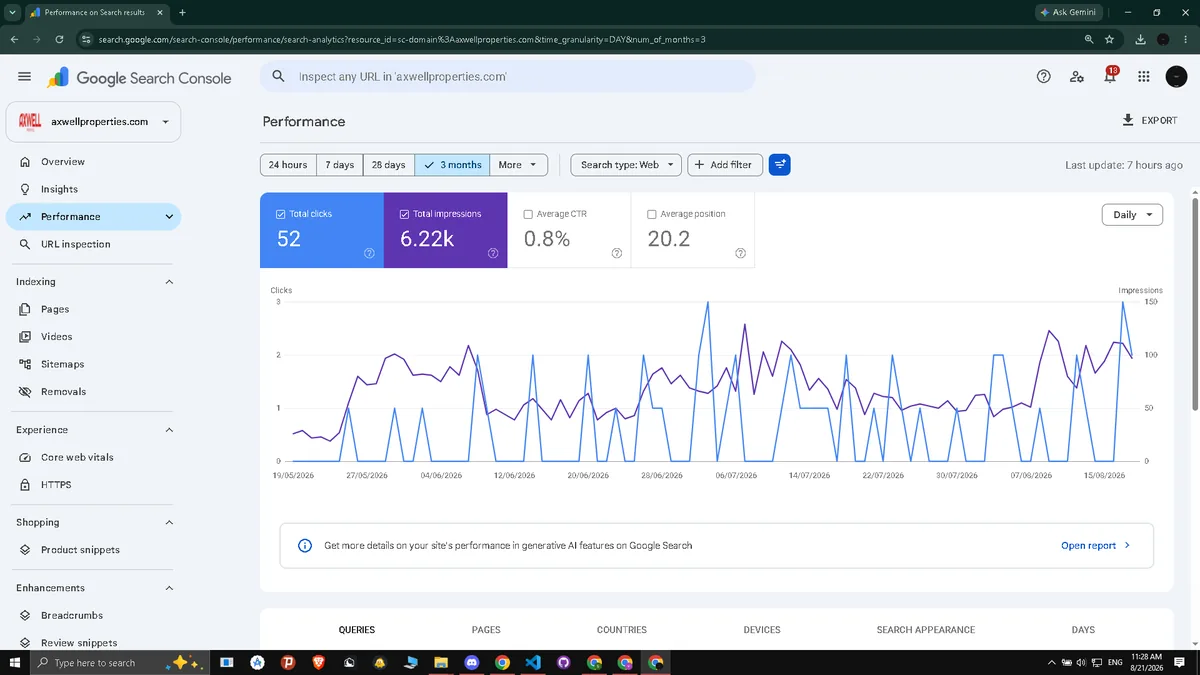
- The supplied three-month Search Console screenshot shows 52 clicks, 6.22K impressions, 0.8% CTR, and average position 20.2 for the selected period.
- This page owns branded Axwell proof intent. Generic website-company, real-estate SEO, and website-pricing searches remain with their dedicated pages.
Project Context: Real-Estate Buyers Need Discovery Before They Need a Form
Axwell Properties serves buyers looking across the Red Sea market. On the live site, users can move from the homepage into projects, featured developments, locations, and the Soma Bay collection before they are asked to register interest. That structure matters because high-ticket property decisions usually require exploration before conversion.
The current Axwell footer credits IDEONIC Solutions as the website developer. This case study uses the live site as the primary product evidence and the supplied Search Console screenshot as a dated search-visibility snapshot. It does not invent lead counts, sales figures, or ROI that were not provided.
Website Experience: From Brand Promise to Project Discovery
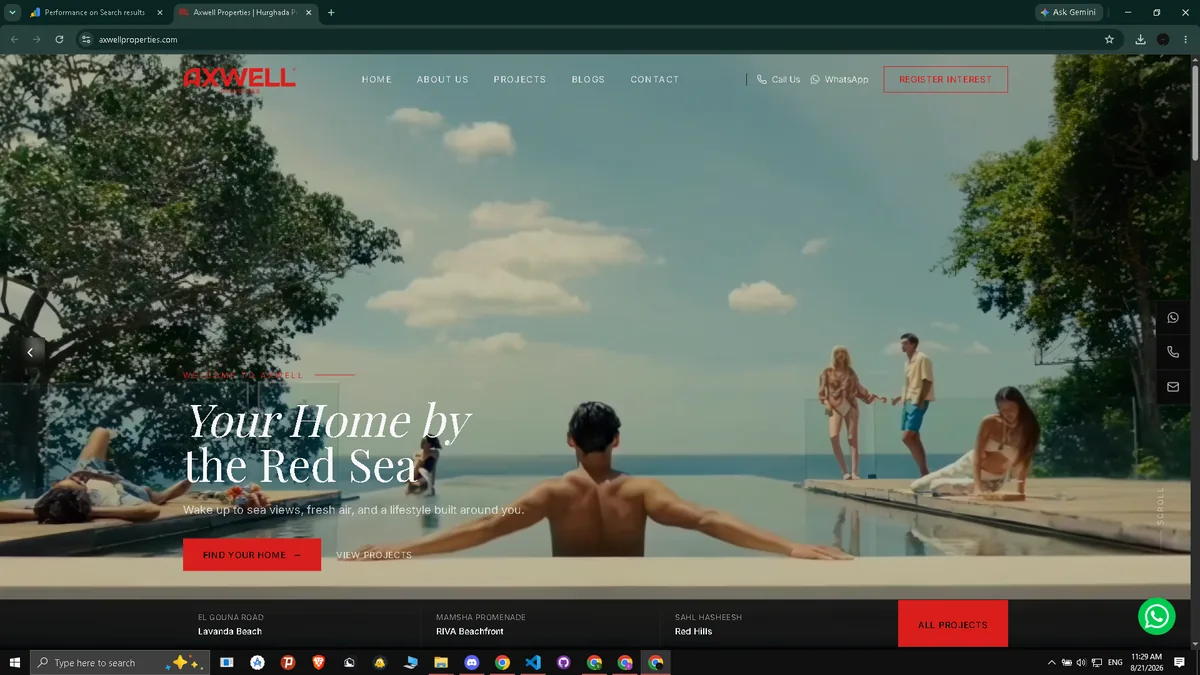
A property website should not behave like a static company brochure. It has to help buyers answer location and project questions quickly, then preserve enough visual quality to support trust. Axwell's current homepage creates multiple discovery routes: highlighted projects, latest developments, featured properties, the Soma Bay collection, and contact actions.
- ✓Clear project entry points above the fold and throughout the homepage.
- ✓Dedicated project and location surfaces instead of a single undifferentiated gallery.
- ✓Visible contact actions for users who are ready to speak with the sales team.
- ✓Editorial and project content that can be expanded into a search cluster over time.
Search Architecture: Each Development Needs a Reason to Be Indexed
For real-estate SEO, every project page competes with portals, developers, brokers, and other agencies. The page therefore needs more than a project name and image gallery. It needs a distinct topic, meaningful location context, descriptive project information, internal links, structured metadata, and a conversion action that matches the buyer stage.
That is why this Axwell case study links to the existing real-estate SEO in Egypt guide for generic organic-search strategy and to the web design company in Egypt page for service-selection intent. This page stays focused on the named project and its implementation evidence.
Supplied Search Console Snapshot: 6.22K Impressions
52
Clicks
6.22K
Impressions
0.8%
CTR
20.2
Average position
The current snapshot is useful because it reveals both traction and opportunity. Thousands of impressions mean Google is already testing and surfacing pages for relevant searches, while the average position and CTR show there is still substantial room to improve rankings and snippets. A serious SEO process should use that gap to prioritize pages rather than treating the screenshot as a finished success story.
What We Would Keep Strengthening From This Baseline
- 01
Improve pages already earning impressions
Use GSC query-to-page data to identify project pages sitting outside the strongest positions and improve the content, title, internal links, and intent match.
- 02
Build location authority
Connect project pages to strong location hubs for Hurghada, Sahl Hasheesh, Soma Bay, and other real demand areas without creating duplicate city pages.
- 03
Raise CTR where rankings are already viable
Titles and descriptions should communicate project type, location, buyer value, and next step instead of repeating generic luxury language.
- 04
Connect editorial content to commercial pages
Investment and buying guides should support the exact projects and locations they discuss, creating a crawlable path from research to enquiry.
Why the Axwell Snapshot Is an Opportunity Map, Not a Finish Line
The supplied Axwell snapshot shows a site already receiving thousands of search impressions but with an average position of 20.2 and a 0.8% CTR across the selected period. That combination is useful because it points to a practical optimization phase: Google is finding and testing the content, but many impressions are still happening outside the strongest click positions. The next gains are likely to come from improving pages that already have evidence of relevance.
The correct workflow is query-to-page analysis. For each high-impression page, inspect the actual search terms, current position distribution, snippet, competing results, content depth, internal links, and whether another Axwell page is being shown for the same intent. If the right page is already ranking around positions 8-20, improving that page is usually safer than creating another URL targeting a near-identical phrase.
CTR work should also be selective. A low CTR at position 20 is not primarily a copywriting problem; the ranking itself limits clicks. A low CTR at position 4-8 deserves closer title and snippet testing. This distinction prevents teams from endlessly rewriting metadata while ignoring the more important ranking and intent issues underneath it.
That makes Axwell a useful example of honest reporting: the visibility is real, but the opportunity is still open. A credible case study can show both traction and the next problem to solve instead of presenting every graph as a finished win.
Frequently Asked Questions
Did IDEONIC build the Axwell Properties website?+
Yes. The current live Axwell Properties footer publicly credits IDEONIC Solutions as the developer. The case study therefore uses the live site itself as verifiable web-development evidence and separately uses the supplied Google Search Console screenshot as a dated search-visibility snapshot.
What does the Axwell Search Console snapshot show?+
The supplied three-month screenshot shows 52 clicks, 6.22K impressions, a 0.8% CTR, and an average position of 20.2. Those numbers show current organic visibility and a meaningful opportunity to improve ranking positions and search-result click-through rates; they are not a guarantee of future results.
Why is Axwell a website case study rather than a generic web-design page?+
Because the search intent is different. This page proves a named implementation and explains project-specific decisions. The existing web design company page owns provider-selection queries, while the website development cost guide owns pricing. Separating those intents reduces internal competition and creates stronger contextual links between proof and service pages.
What should a real-estate website prioritize for SEO?+
It should give major projects, locations, and buyer questions clear crawlable pages; use descriptive metadata and internal links; keep mobile performance strong; connect informational content to relevant commercial pages; and measure query-to-page performance in Search Console so weak pages can be improved rather than duplicated.
Final Takeaway
Axwell Properties is useful as a case study because the website is live, the developer credit is public, and the supplied Search Console snapshot shows where search visibility currently stands. The combination gives buyers evidence they can inspect while also showing that SEO is an ongoing optimization process rather than a one-time launch task.
For proof across more projects, use the digital marketing case-studies pillar. For a buyer focused on rebuilding their own site, continue to the website redesign case study.